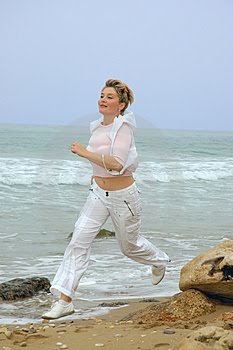
Saturday, July 10, 2010


EXERCISE FOR GOOD HEALTH & FITNESS


Aerobic exercise (walking, jogging, dancing, biking, swimming, etc.): To promote and maintain health, older adults need moderate-intensity aerobic physical activity for a minimum of 30 minutes five days each week or vigorous intensity aerobic activity for a minimum of 20 minutes three days each week. (Moderate intensity is when you feel "warm and slightly out of breath," and vigorous is when you feel "out of breath and sweaty.")


Resistance exercise (weight lifting, calisthenics): To promote and maintain health and physical independence, older adults will benefit from performing activities that maintain or increase muscular strength and endurance for a minimum of two days each week. It is recommended that eight to 10 exercises be performed on two or more nonconsecutive days per week using the major muscle groups.


Flexibility exercise: To maintain the flexibility necessary for regular physical activity and daily life, older adults should perform activities that maintain or increase flexibility at least two days each week for at least 10 minutes each day.


Balance exercise: To reduce risk of injury from falls, older adults with substantial risk of falls (for example, with frequent falls or mobility problems) should perform exercises that maintain or improve balance.

Sunday, July 4, 2010


Weight Loss


1. Stretch your meals to, at least, 20 minutes or longer. Your stomach, mouth and brain are all connected and it takes 20 minutes of chewing before your stomach signals your brain that you are full. To feel full and successfully lose weight on any weight loss program, you need to eat slowly for 20 minutes or longer.


2. Drinking 8 glasses of water a day is important to your health, your normal diet and to help lose weight. Water is necessary for the metabolism of your stored fat. Weight loss cannot occur without an active metabolism which requires large quantities of water. Another way to use water to lose weight is to drink a large glass of ice water just before meals. The cold causes your stomach to shrink slightly which will make you feel full faster.


3. The more positive your self-esteem, the better you feel about yourself, the faster and easier it will be for you to lose weight. When you are self-confident, you are better able to take charge of your life. It also means that after you lose weight, it will stay gone permanently.


4. When you go fat free or low fat, you also cut out much of the taste of the foods you eat. Add the flavor back with herbs and spices. Strong flavors such as vinegar, garlic, chili powder, cayenne, curry powder, rosemary and tarragon can be used to doctor up any food you are eating. For your low fat and fat free diets, experiment with different herbs and spices until you find some you like. Staying on your fat free or low fat diet will be easier and your weight loss will be speeded up.


5. Increase your metabolism by as much as 40% by using hot and spicey foods such as hot peppers of all varieties and mustards. Research shows these foods all increase your metabolism. For double duty, give up fat filled mayonnaise for mustard and add hot peppers to your food for greater flavor and increased metabolism.


6. Negative emotions will also interfere with your weight loss program. It's difficult to stay motivated to lose weight when you feel bad. Overeating often accompanies negative emotions such as depression, anxiety, fear, guilt and anger. If this is true for you, begin a stress management program including some exercise and relaxation exercises.


7. To lose weight faster, reduce your intake of caffeine. Caffeine leads to an increase of insulin in your body which retards the burning of your stored fat.This is a simple chemical reaction in your body that you can change. Reduce your caffeine intake by 50% and see what happens. Here is a rough guide to use when looking at the amount of caffeine you currently take in: Brewed coffee (6 oz. cup) - 100mg; Instant coffee (6 oz.) - 70mg; Tea (6 oz.) - 50mg; Soft drinks (12oz.) - (Coke, Dr. Pepper, Mountain Dew) - 50mg; Dark chocolate (1 oz.) - 20mg and Milk chocolate (1 oz.) - 6mg.


8. Incease your intake of fiber rich foods. They will help fill you up faster and will help all the food you eat pass through your digestive system more easily.


9. Exercise is probably the most important key to increasing your metabolism and burning off excess fat. Research shows that you burn more stored fat for energy when you do aerobic exercises on an empty stomach than on a full stomach. Research also shows that you burn more stored fat when you exercise late in the day rather than in the morning. Put together, the best time to exercise to lose weight by burning your stored fat is in the late afternoon/early evening before dinner. Second best is in the morning before breakfast. Our metabolism naturally starts to slow down about 8 hours after we wake up. Thirty minutes of aerobic exercises in the evening, before dinner, will not only burn off stored fat but it increases your metabolism for about two to three more hours just when it was starting to slow down. This produces a significant increase in fat burned off, even after the exercise is over.


10. To lose weight quickly, never skip a meal. Your first meal after waking starts your metabolism. Your metabolism then speeds up for about eight hours and then starts slowing down until you go to sleep when it goes to low until you wake and eat and start the cycle again. Skip breakfast and your metabolism doesn't get started until lunch time. You've just missed three or four hours of fat burning time. When you skip meals during the day, your metabolism also slows down. Weight loss through the burning of stored fat is all about eating enough of the right kinds of foods so you stay full and your metabolism stays as high as possible. Remember, if you feel hungry, your metabolism slows down. Stay full with healthy, nonfattening foods and your metabolism will continue to burn your stored fat as fast as your body will allow.

Tuesday, June 29, 2010


PHYSICAL EDUCTION/BODYFITNESS


1. Physical education is needed because due to advanced technology the lifestyle of people becomes sedentary and they become passive entertainer.


2. Physical education is needed during

elementary & secondary education for proper growth and development.


3. It is beneficial during adulthood to maintain good health and fitness.


4. During old Age, physical education is important to prevent and treat various ailments and disease.


5. It is important as it provides us the knowledge of our bodies from musculoskeletal, physiological and biochemical point of view.


6. It teaches us various physical activities that can be practised now in later life such as motor skills for the games and sports of volleyball, tennis, swimming and so on.


7. It also teaches us the value of ethical behaviour in sporting situations.


8. It teaches us the value of physical fitness and how to become physically fit.


9. It teaches us the value of physical fitness and how to become physically fit.


10. It is important for aesthetic reasons as by participation in physical fitness programmes like gymnastics and dance, beauty and grace in cultivated in the movement.


11. It is also important for catharsis reasons with mean releasing of energy, emotion, tension or frustration and some people let off their extra steam by participating in various games and sports which are part of physical education. This way physical education helps in checking juvenile delinquency.

Thursday, April 29, 2010

RUNNING


RUNNING


1. Frequency of training: three to five days per week


2. Intensity of training: 55/65%-90% of maximum heart rate (HRmax)


3. Duration of training: 20-60 minutes of continuous or intermittent aerobic activity


4. Mode of activity: any activity that uses large muscle groups, which can be maintained continuously, and is rhythmical and aerobic in nature (for example, walking-hiking, running-jogging, cycling-bicycling, cross-country skiing, aerobic dance/group exercise, rope skipping, rowing, stair climbing, swimming, skating, and various endurance game activities or some combination thereof)
Running and jogging are right there, and they count!

What are proper running techniques?
Beginner tips
Sure, you could go out and just run, and there's no evidence to suggest that that won't work just fine. But if you're struggling with running, or something just doesn't feel right, then it might be worth paying attention to your form. The following tips for correct running form are adapted from Runner's World Magazine and Jeff Galloway. I'll start at the top and work down.


Head: You should look forward toward the horizon when you run. To do that, keep your head on top of your spine and do not bend forward or look down at your feet. Your head weighs at least 13 pounds, and you don't want it dragging you down with forward-head posture! The emphasis is on keeping your body erect, because you're fighting gravity when you lean forward (it's okay if you look down at the ground at least 20 feet ahead of you since you won't lean forward to do that). Keep your face and jaw relaxed, too; it's okay if they shake and bounce as you run.


Shoulders: Keep them relaxed and loose. Shrugging, tightening, and creating tension in your shoulders and neck will waste energy and deplete you quickly. Stay loose as a goose!
Torso: As Jeff Galloway says, "Your torso's only along for the ride." Track coaches describe the ideal posture as running tall, which means that you stretch yourself up to full height with no strain from the torso. This will allow you to breathe maximally and put your body in the optimal biomechanical position for moving forward.


Hips: Your hips are close to your center of gravity and will be in proper alignment if your torso and head are aligned. If you lean forward, your hips will tilt forward too and that will strain your lower back.


Legs: Sprinters lift their knees very high when they run, but for distance running, and even shorter distances, keep your knees low. It takes a lot of energy to lift your knees, and even running a mile will be tough if you do so. Instead, quicker ankle action will help you increase your speed.


Ankles: Your ankles are efficient levers that have the potential for great power when you run. Feel your calf muscles and ankles work as you push off on each step.


Arms: Arms should remain close to the body and swing forward and back and not across your body to minimize torso rotation (the exception is Bill Rodgers who had memorably wide elbows when he ran). Your hands should not cross the midline of your body (imagine a line drawn right down the center of your chest). The swing should be held low, elbows bent at a 90-degree angle and relaxed. You should do most of the work with your lower arms; the upper arms should not move very much.


Hands: Cup your hands by gently touching your thumb to the top half of your index fingers. It's as if you are holding a small bird that you don't want to fly away but you don't want to squeeze too tight either.

Saturday, April 24, 2010

WEIGHT LOSS - WALKING / RUNNING


WEIGHT LOSS - WALKING / RUNNING


To my knowledge, there are no studies to show that runners lose more weight than individuals who do other types of exercise. However, running certainly does burn lots of calories, and if you're running regularly, you might decide not to eat as much figuring why do it if you're putting all that energy into running. But even if you ran a marathon every day, you wouldn't lose weight unless you consumed fewer calories than you burned. The bottom line to losing weight is burning more calories than you consume, no matter how much exercise you do.


According to the laws of physics, you should burn the same number of calories whether you walk or run the same distance. However, there is recent research to show that running one mile burns approximately 30% more calories than walking one mile, and it's true whether you run outdoors or on a treadmill. The research is mixed, and so it's hard to know for sure if you'll burn more calories running than walking. My take on it is that it doesn't matter whether you walk or run during weight-loss efforts because you'll lose weight as long as you reduce your calories enough to burn more than you are consuming, no matter how much, or what type of exercise you do. What is important is that you maintain some type of exercise once you reach your goal weight, because it's generally accepted that exercise is the single best predictor of keeping your weight off. Whether you walk or run won't matter. The key is to do something.


You'll get equally fit running on a treadmill or outdoors. In fact, many distance-running athletes use the treadmill to save their legs from the pounding of roadwork. But there is a slight difference in energy expenditure (calories burned) between the two; outdoor running burns slightly more calories than treadmill running at the same speed due to lack of air resistance on the treadmill. Researchers studying this phenomenon found that setting the treadmill at 1% elevation equals things out. I advise all of my clients to set the treadmill at 1% so that treadmill walking or running mimics outdoor exercise.

Sunday, April 11, 2010


EARLY MORNING EXERCISE


The key is getting exercise whenever you can, whether it's morning, afternoon, or evening, but by starting your morning with physical activity, you set the day's pace. You get your exercise in before other distractions can intrude.


When you exercise early in the morning, it jump starts your metabolism and keeps it elevated for hours, sometimes up to 24 hours! That means you're burning more calories all day long just because you exercised in the morning!


When you exercise in the morning, you'll find that because of the increased intake of oxygen and circulation of blood in your body, you'll stay energized for the whole day.


It will automatically put you in a healthy frame of mind. Whatever other things you may have on your schedule, you will notice that you will be eager and energetic to handle them.


Research has proven that people who exercise in the mornings tend to be the ones most consistent in their fitness regimes and diets.

Saturday, April 3, 2010

Muscle Strength


Muscle Strength


If you are considering adding some bulk to a thinner frame, and you wish to accomplish this through varied methods it takes some creative thinking on different ideas to start with. Because of this it is necessary for you to know the various advantages that bodybuilding in general has to offer.


Body Building Exercises DefinedDeciding what body building exercises to use can be somewhat challenging due to the fact that there are so many variations available. However, once you figure out which body parts you want to work on you can narrow down your choices quickly.Numerous up and coming body builders are of the mindset that the only real way to build muscles on their arms is to lift weights. This is not exactly the case, since lifting weights is certainly a beneficial body building exercise, it is not a good idea for beginners to do that prior to getting some arm strength through other ways.


Specifically, an ideal exercise to build the back of your arms (triceps) is pushups. Depending on the physical condition of a person prior to starting exercise pushups may be difficult to do, but pushups are an excellent way to begin and at the same time it reduces the chance of injury.


Gradual IncreasesStart with just a few pushups, and as soon as you feel your the muscles in your upper arm begin to burn, stop.If you are not in shape it is wise to start with only two sets of 15 repetitions each. Some even advise starting with as little as 10 repetitions. Gradually you will you will gain strength in the back of your arms.


Pushups also have a strengthening effect on your shoulders due to the movement of the exercise and because you are supporting your upper body weight with this exercise.For strengthening and building your legs the exercises of squats and leg lunges are an effective option. For those just starting out it will tend to be uncomfortable until your body becomes accustomed to it.